






If you’ve attended a construction conference, watched a product demo, or opened LinkedIn recently, you’ve probably noticed one thing: Everyone is talking about AI.
Some vendors claim it can complete takeoffs automatically. Others promise it can identify every scope item, read every specification, and practically build the estimate for you. It’s enough to make any estimator wonder what’s real and what’s just marketing.
The honest answer sits somewhere in the middle. AI is already making estimators faster in meaningful ways, particularly during the item identification stage of a takeoff. But it still can’t replace the judgment that separates an average estimate from a competitive one.
That’s not a limitation to gloss over. It’s the most important thing to understand when evaluating AI-powered estimating software. Here’s where AI genuinely delivers today and where experienced estimators remain irreplaceable.
What Is AI in Construction Takeoffs?
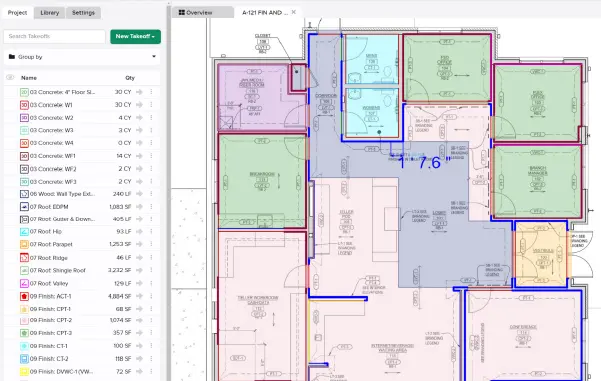
AI-assisted construction takeoff uses machine learning and computer vision to identify objects, assemblies, symbols, and patterns within construction drawings. Rather than replacing the estimator, it helps surface likely items for review, allowing estimators to spend less time searching through plans and more time validating scope.
The goal isn’t to remove people from the estimating process. It’s to eliminate repetitive work so experienced estimators can focus on decisions that require expertise.
What AI Gets Right: Finding What's Already There
Anyone who’s completed a large commercial takeoff knows that identifying every scope item takes concentration. You’re scanning hundreds of plan sheets looking for walls, doors, windows, fixtures, assemblies, and countless repeating elements. Missing even one item can affect the final bid. The work isn’t difficult because it’s technically complex, it’s difficult because it requires relentless attention to detail.
This is where AI excels. Modern AI models are exceptionally good at recognizing patterns across large amounts of visual information. Instead of manually searching every sheet for a particular wall type or door symbol, AI can scan the drawing and quickly highlight likely matches. That changes the estimator’s role.
Instead of spending 45 minutes hunting for every occurrence of an assembly, AI can present potential matches in seconds. The estimator then reviews each suggestion, confirms what’s correct, rejects what isn’t, and handles the exceptions. That’s a meaningful productivity improvement.
The AI isn’t making decisions, but it is surfacing possibilities. The estimator is still responsible for confirming every item before it’s included in the takeoff. Think about spell-check in a word processor. Spell check doesn’t write your report, it simply flags words that deserve another look. Good spell-check saves time while leaving the writer in control. AI-assisted item detection works much the same way.
At STACK, AI-assisted item detection is designed around this philosophy. The software surfaces candidate items for review, while the estimator remains responsible for confirming scope before quantities become part of the estimate.
Where AI Still Falls Short: Context Matters
Finding an item isn’t the same as understanding it. That’s where AI still has work to do.
Two projects might contain the exact same wall assembly on paper. That doesn’t necessarily mean they’re estimated the same way. One contractor may include blocking within their scope. Another may exclude it. One estimator may carry additional labor because of project complexity. Another may have a subcontractor relationship that changes pricing assumptions.
None of that context exists within the drawing itself, it’s built from experience. It’s shaped by company standards, customer expectations, historical performance, and years of estimating similar work. AI can’t reliably interpret those business decisions because they aren’t visual patterns, they’re judgment calls.
The same challenge appears when projects contain unusual details.
Most jobs include exceptions:
- A specification note buried on page 68.
- An alternate detail issued through an addendum.
- A substitution that changes material requirements.
The Last Three Percent
Imagine AI successfully identifies 97% of the relevant scope items on a project. That’s impressive and saves significant time. But what about the remaining three percent? Those are often the details that determine whether an estimate is accurate.
- They're the coordination issue hidden between architectural and structural drawings.
- They're the specification note that changes an assembly.
- They're the unusual condition that affects labor production.
- They're business risks.
Experienced estimators know those details deserve extra attention because they’ve seen what happens when they’re overlooked. That judgment remains one of the profession’s greatest competitive advantages.
Interested in seeing AI-assisted item detection in action?
We’ll show you how STACK keeps estimators in control while accelerating item identification.
Book a 20-minute demo: www.stackct.com/schedule-a-demo →
What Changes in an AI-Assisted Workflow?
One of the biggest misconceptions about AI is that it replaces estimators. A more accurate way to think about this is that it changes where estimators spend their time.
Without AI, much of the day is spent searching.
- Searching drawings.
- Searching specifications.
- Searching for repeated assemblies.
- Searching for missed items.
With AI handling much of that repetitive discovery, estimators spend more time reviewing scope, validating assumptions, resolving conflicts, and improving estimate quality.
Those are higher-value activities. And they’re exactly where experienced professionals create the most value. Rather than replacing expertise, AI shifts more of the work toward expertise.
Better Data Makes Better AI
Every completed project generates valuable estimating knowledge.
- Assemblies.
- Preferred inclusions.
- Historical production rates.
- Common exclusions.
- Typical project conditions.
When that information lives inside connected estimating software instead of scattered across spreadsheets and folders, it becomes institutional knowledge. Over time, AI-assisted platforms become better at recognizing how your company estimates work. Not because they replace estimator judgment, but because they’re learning from consistent workflows and historical project data. That benefits the entire estimating team.
- New estimators ramp up faster.
- Senior estimators spend less time answering repetitive questions.
- Estimating standards become easier to maintain across projects.
Instead of expertise living inside one person’s head, it becomes part of the organization’s workflow.
The Estimator Is Still the Competitive Advantage
Construction estimating has never been just about counting. It’s about:
- Understanding scope.
- Reading between the lines.
- Recognizing risk.
- Making informed assumptions.
- Knowing when something doesn't look right.
AI helps with many repetitive tasks that consume an estimator’s day. It can identify patterns, surface likely assemblies, reduce manual searching, and catch things that might otherwise be overlooked under deadline pressure. But it still depends on human expertise to determine what belongs in the estimate, and that’s unlikely to change anytime soon.
The best estimating teams will be the ones that use AI thoughtfully, allowing technology to handle repetitive work while estimators focus on decisions that require experience.
That’s where the greatest value has always been, and it’s where it will continue to be.
Ready to see AI that supports—not replaces—your estimating team?
See how STACK combines AI-assisted item detection with estimator expertise in one connected workflow.
Schedule a demo: www.stackct.com/schedule-a-demo →
FAQ
AI construction takeoff software uses machine learning and computer vision to identify objects, assemblies, symbols, and other scope items within construction drawings. The technology accelerates takeoffs by helping estimators find items more quickly while leaving review and approval to the user.
No. AI can automate repetitive tasks such as identifying recurring items and recognizing drawing patterns, but it cannot reliably make project-specific scope decisions, interpret business strategy, or replace estimator judgment.
AI reduces the time spent manually searching drawings by surfacing likely matches for walls, doors, fixtures, assemblies, and other repeated elements. Estimators can then verify those suggestions rather than searching for them manually.
AI struggles with project context, unusual conditions, buried specification notes, contractor-specific scope decisions, and the judgment required to evaluate risk. These are areas where experienced estimators continue to provide the greatest value.