







- STACK isn’t just adding AI features—it rebuilt its platform around AI to reduce friction, improve workflows, and prioritize long-term performance over quick wins.
- New features like precise dimensions, shape-based measurements, and quantity breakouts help eliminate errors and increase estimator confidence—because mistakes cost more than time.
- From a smarter toolbar to enhanced plan navigation, STACK’s updates focus on reducing clicks and manual effort across thousands of small actions that add up in every bid.
- Features like negative quantities, cost templates, and project-level currency allow contractors to handle complex, global, and multi-scope projects without workarounds.
STACK’s latest construction takeoff software features in 2026 are redefining how estimators work, and our Q1 releases are a clear signal of where the industry is heading. Faster workflows matter, but accuracy, adaptability, and long-term scalability matter more. That’s exactly where STACK has focused its innovation.
STACK didn’t just layer AI on top of existing workflows, we restructured how software is built and delivered. The result is a platform that helps contractors produce faster takeoffs and estimates without sacrificing precision or control.
What Are Construction Takeoff Software Features?
Construction takeoff software features are digital tools that allow estimators to measure quantities, calculate costs, and build bids directly from plan sheets. Modern platforms combine measurement tools, cost databases, and automation to improve speed and accuracy.
Advanced solutions—like STACK— incorporate AI, real-time collaboration, and workflow automation to reduce manual effort and improve estimating consistency.
"We want to be better, not just faster. Those aren’t the same thing. We’re deliberate about the decisions that shape the platform long-term. We make trade-offs every day. That’s the reality of building software. But there’s a difference between a trade-off and a shortcut. Trade-offs are responsible. Shortcuts are debt. We know the difference."
Ariel Alonso, STACK VP of Engineering
Why AI-First Engineering is Changing Takeoffs and Estimating
The pressure on preconstruction teams has never been higher. Labor shortages, tighter bid timelines, and rising material costs mean estimators must produce more accurate bids in less time. Incremental updates—small UX tweaks or isolated automations—aren’t enough anymore.
STACK recognized that and made a structural shift:
- Rebuilt engineering workflows around AI capabilities
- Prioritized long-term platform performance over short-term speed gains
- Focus is on reducing estimator friction at every step
At STACK, we have seen customers reduce takeoff time significantly when workflows are simplified. That distinction is critical. Faster clicks don’t matter if rework increases later.
How STACK’s Q1 Features Help You Produce Faster Takeoffs and Estimates
STACK’s Q1 updates focus on eliminating friction across the entire takeoff and estimating workflow—from measurement to cost calculation to plan navigation.
1. Smarter takeoff workflows reduce manual effort
STACK introduced a redesigned, context-aware toolbar that adapts to how estimators work.
- Faster access to frequently used tools
- Reduced clicks during measurement workflows
- Improved visibility of active tools and settings
Learn more about the smarter takeoff toolbar.
Why it matters:
Estimators often perform thousands of small actions per bid. Even minor inefficiencies compound quickly. Streamlining tool access can save hours across large projects.
"Bulk scales was a fun one. ISCO Industries, a large piping company out of Louisville, KY, was spending hours setting the scale on 50 to 60 sheet plan sets. We estimate it saves them an hour or two every week — just from that one change."
David Fouché, STACK Senior Product Manager
2. More precise measurements lead to more accurate estimates
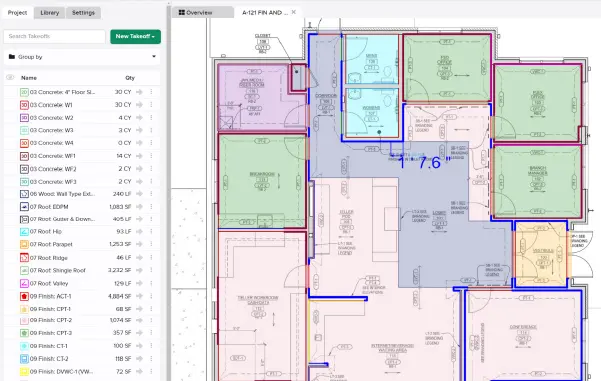
Accuracy is everything in estimating. STACK enhanced measurement precision with improved dimension controls and shape-based takeoffs.
- Exact dimension inputs for shapes
- Better control over measurement geometry
- Reduced rounding errors
“STACK allows us to be very, very accurate. I can be 100% when I turn over numbers, whether it's to an owner or to my own office. We're confident in our ability to do the work that we've promised our clients because of STACK.”
Grant Larson, Michael Manning Roofing Services
3. Advanced quantity handling eliminates workarounds
Real-world takeoffs aren’t always straightforward. STACK introduced more flexibility in how quantities are calculated and adjusted.
Support for negative measured quantities
More accurate deductions and adjustments
Better alignment with real-world estimating scenarios
See how negative measured quantities work.
STACK Hot Tip:
In complex scopes—like renovations or phased builds—estimators often need to subtract areas or adjust quantities dynamically. Previously, this required manual corrections outside the system. Now it’s built directly into the workflow.
"Negative measured quantities addressed a real pain point: you've submitted a bid, and then the contractor comes back with a change order to remove scope. You don't want to delete those measurements — you want to show what went in and what came out. For Elemex, an exterior contractor in London, ON, that means significant time savings and much cleaner plans and estimates."
David Fouché, STACK Senior Product Manager
4. Quantity breakouts improve cost visibility
Estimators need to understand not just total quantities, but how those quantities are derived. STACK added enhanced quantity breakout capabilities tied to measurement inputs.
- Clear breakdown of how quantities are calculated
- Better transparency for assemblies and costs
- Easier validation and review
Learn more about quantity breakouts by measurement inputs.
This is especially valuable for teams collaborating across estimating and project management—where clarity reduces back-and-forth.
5. Flexible cost structures support real-world estimating
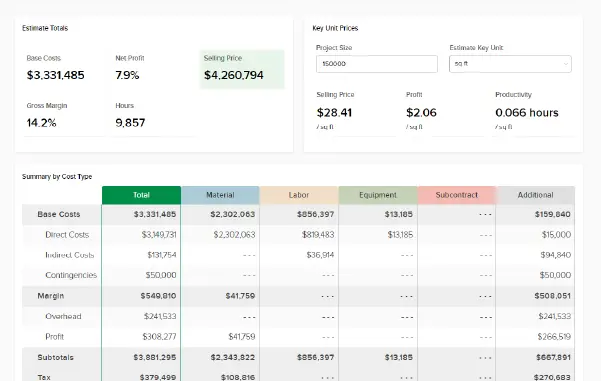
STACK introduced Other Costs Templates, allowing teams to standardize non-material and non-labor costs.
- Easily apply recurring cost structures
- Standardize indirect costs across projects
- Improve bid consistency
Explore Other Costs Templates.
We’ve seen customers improve bid consistency significantly when indirect costs are standardized instead of manually recreated for each estimate.
6. Project-level currency enables global workflows
For contractors working across regions, currency flexibility is essential. STACK now supports project-level currency settings.
- Assign currency at the project level
- Improve accuracy for international projects
- Reduce manual conversions
See details on project-level currency.
7. Enhanced plan viewing improves speed and navigation
Plan navigation is a major time sink in takeoffs. STACK improved plan viewing performance and usability.
- Faster loading plan sheets
- Smoother zoom and pan interactions
- Improved clarity and usability
- Grayscale drawings option cuts down visual noise
Learn about plan viewing enhancements.
"Errigal Group — an interiors contractor in Monaghan, Ireland — works with color-coded floor plans, and the takeoff colors were clashing with the plan colors and making everything harder to read. When we shipped grayscale drawings, they were ecstatic. It simplifies their workflow, improves communication with their clients, and makes everything cleaner. The biggest win: they don't have to think about the app anymore — they just focus on the task."
David Fouché, STACK Senior Product Manager
Manual vs. Connected Estimating Workflows
Feature | Manual Takeoff | Traditional Digital Tools | STACK AI-Enhanced Takeoff |
|---|---|---|---|
Speed | Slow, labor-intensive | Moderate | Fast with automation |
Accuracy | Prone to human error | Improved | High precision with AI support |
Flexibility | Limited | Moderate | High (dynamic adjustments, breakouts) |
Collaboration | Difficult | Some sharing | Real-time cloud collaboration |
Scalability | Low | Moderate | High across teams and projects |
How to Take Advantage of These New Features in Your Workflow
Adopting new features isn’t just about turning them on—it’s about integrating them into your estimating process.
Step-by-step approach:
1. Standardize your assemblies and cost structures
Use templates like Other Costs to ensure consistency across bids.
2. Train your team on updated measurement tools
Focus on precision features and quantity breakouts.
3. Leverage AI-assisted workflows in STACK Takeoff & Estimate
Reduce manual input and speed up repetitive tasks.
4. Optimize plan navigation workflows
Take advantage of enhanced viewing and toolbar improvements.
5. Review and refine your process regularly
Use reporting and insights to identify inefficiencies.
How STACK Supports Compliance and Audit-Ready Estimating
Accurate documentation is essential for compliance with contracts, audits, and regulatory requirements.
STACK’s cloud-based platform provides:
- Clear audit trails for takeoff changes
- Documented quantity calculations and breakouts
- Centralized plan and estimate management
This is particularly valuable when working under strict requirements like OSHA standards or contract-based documentation expectations.
"STACK helps us in efficiency so you're not having to constantly spend time going to look for items It's right there at your fingertips. You've got the audit trail. It also helps for accuracy because if you're doing multiple homes of the same type and you're giving different takeoffs for different ones you can lose credibility to your customers. Being able to go and access that home that you've taken off or any kind of access for estimates then it just looks more concise more consistent for that audit."
ProFormance Builder Solutions, Roofing Contractor, Winter Garden, FL
A Deeper Look: Why “Better” Beats “Faster” in Estimating Software
Speed is easy to chase. True performance improvement is harder. STACK’s engineering philosophy reflects a deeper understanding of construction workflows:
- Estimators don’t just need speed—they need confidence
- Errors cost more than delays
- Scalable systems outperform quick fixes
This is where many tools fall short. They optimize for clicks, not outcomes.
By contrast, STACK’s approach—especially with AI takeoff capabilities—focuses on reducing cognitive load, improving visibility, and enabling better decisions.
Smarter Takeoffs Start With Better Systems
STACK’s latest construction takeoff software features in 2026 aren’t just about automation, they’re about building better workflows.
STACK’s Q1 updates show what happens when a platform is redesigned for an AI-first world:
- Less friction
- Greater accuracy
- More scalable estimating processes
And most importantly, better outcomes for contractors.
"Our most recent update, Search in Item Groups, Kennedys Group and Errigal Group both have extensive item lists — sometimes 20, 30, 50 items — many of them nearly identical. Scrolling to find the right one was a constant friction point. Now they just type and the list filters instantly. Same theme across all of these: we're getting customers out of the app and back to the work.
David Fouché, STACK Senior Product Manager
FAQ: Construction Takeoff Software Features
What are the most important takeoff software features in 2026?
The most important features include AI-assisted measurements, precise dimension controls, quantity breakouts, and cloud collaboration. These capabilities help improve both speed and accuracy in estimating workflows.
How do new STACK features improve estimating accuracy?
STACK’s features—like precise dimensions and quantity breakouts—reduce manual errors and provide better visibility into calculations. This ensures estimates are more reliable and easier to validate.
Why is AI important in construction takeoff software?
AI helps automate repetitive tasks, identify patterns, and reduce manual input. This allows estimators to focus on decision-making rather than data entry, improving both speed and accuracy.
Can these features help with complex projects?
Yes. Features like negative quantities and advanced breakouts are specifically designed for complex scenarios such as renovations, phased construction, and multi-scope projects.
How can teams adopt these features effectively?
Teams should standardize processes, train users on new tools, and integrate features into daily workflows. Regular review and optimization ensure maximum value from the platform.