








Markup and margin are two of the most commonly confused terms in construction estimating. They sound similar, and both deal with profitability, but they calculate it from opposite directions. When an estimator applies a 20% markup thinking it produces a 20% margin, the bid goes out underpriced, and the difference comes straight off the bottom line.
Understanding the key difference between markup vs margin isn’t just an accounting exercise. It directly affects your pricing strategy, your gross profit margin, and how much money your company actually keeps on every job. Here’s how both work, how to calculate them, and how to use them correctly when pricing your next bid.
What’s the Difference Between Markup and Margin?

Markup
Markup is the percentage increase you add to your cost price to reach your selling price. It’s calculated based on what the project costs you. If a job costs you $100,000 and you apply a 20% markup, your selling price is $120,000. The $20,000 difference is your gross profit in dollar terms.
Markup answers the question: how much am I adding on top of my costs?
Margin
Margin is the percentage of your selling price that represents profit. Using the same example, if your selling price is $120,000 and your cost is $100,000, your gross margin is 16.7%, not 20%. That’s because margin is calculated from the sale price, not the cost.
Margin answers the question: how much of each dollar I bring in is actually profit?
Why They’re Not the Same
This is where estimators get tripped up. A 20% markup does not produce a 20% margin. The markup will always be a higher number than the equivalent margin because they use different bases for the calculation. Markup is based on cost. Margin is based on revenue. They’re measuring the same dollar profit from two different angles, and treating them as interchangeable leads to pricing mistakes that eat into your profitability.
How to Calculate the Markup and Margin
Markup Formula
Markup % = ((Selling Price – Cost Price) / Cost Price) x 100
Example: Your cost price is $80,000. Your selling price is $100,000.
Markup = (($100,000 – $80,000) / $80,000) x 100 = 25% markup
Margin Formula
Margin % = ((Selling Price – Cost Price) / Selling Price) x 100
Using the same numbers:
Margin = (($100,000 – $80,000) / $100,000) x 100 = 20% margin
Same dollar profit ($20,000), but the percentages are different because of where each formula starts.
Quick Reference: Markup to Margin Conversion
Markup % | Margin % | Dollar Profit on $100K Cost |
10% | 9.1% | $10,000 |
15% | 13.0% | $15,000 |
20% | 16.7% | $20,000 |
25% | 20.0% | $25,000 |
30% | 23.1% | $30,000 |
35% | 25.9% | $35,000 |
50% | 33.3% | $50,000 |
This table is a quick reference for estimators who need to convert between the two when reviewing bids or building proposals. The gap between markup and margin gets wider as the percentages increase.
Why This Matters When Pricing a Bid

Underpricing When You Confuse the Two
This is the most common and most costly mistake. A business owner who tells their estimator to “price at a 25% margin” will get a very different bid than one who says “add 25% markup.” If the estimator applies a 25% markup thinking it’s a 25% margin, the actual margin on that job is only 20%. On a $500,000 project, that misunderstanding leaves $25,000 on the table.
Impact on Gross Profit and Net Profit
Your gross profit margin is what’s left after direct job costs. But you still have operating expenses to cover: office overhead, insurance, vehicles, software, administrative staff. Your net profit, or net margin, is what remains after all of those are paid. If your markup isn’t high enough to cover both direct costs and operating expenses, your financial performance suffers even on jobs you thought were profitable.
Choosing When to Use Each
In practice, most construction professionals use markup when building an estimate because it’s applied directly to known costs. Margin tends to show up more in financial reporting, income statements, and when evaluating overall business profitability. Both have a place, but knowing which one you’re working with at any given point prevents costly errors in your financial decisions.
Pro Tip: If a contractor or project owner asks for your margin on a bid, make sure you’re not giving them your markup number instead. It’s a common mix-up that can misrepresent your pricing and create problems during negotiations.
How to Set the Right Markup for Your Construction Business
Start with Your True Costs
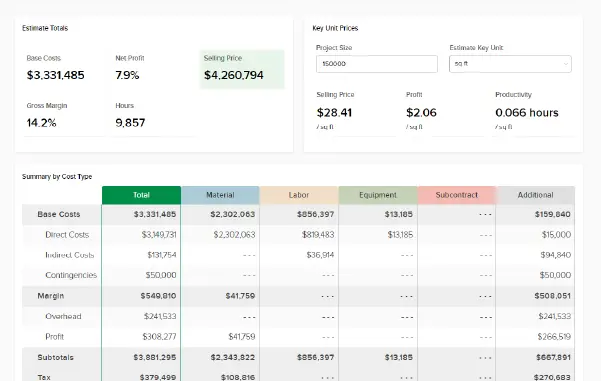
Before you can set a markup rate, you need to know exactly what each job costs you. That means accounting for all direct costs (labor, materials, equipment, subs) and your share of operating expenses and overhead. If your cost numbers are off, no markup percentage will save you. STACK’s estimating tools help your team build detailed, accurate estimates using integrated cost databases and pre-built item libraries, so your markup is built on real numbers, not rough guesses.
Work Backward from Your Target Margin
If you know you need a 20% gross profit margin to cover overhead and hit your profitability goals, use the conversion table above to find the right markup. In this case, you’d need a 25% markup to land at a 20% margin. Working backward from your target margin keeps your pricing strategy grounded in what the business actually needs.
Stay Competitive Without Gutting Your Profit
Every estimator feels the pressure to sharpen their price to win work. But cutting markup without understanding how it impacts your margin can turn a winning bid into an unprofitable job. Use your takeoff and estimating data to find areas where you can tighten costs rather than slashing your markup across the board. A competitive price is only a good price if it still produces a reasonable profit.
Pro Tip: Review your markup and margin by project type at least once a quarter. Some jobs may consistently produce a higher margin than others, and knowing that helps you prioritize the work that’s most profitable for your business.
Price Your Bids with Confidence
Getting markup and margin right is one of the simplest ways to protect your profitability on every bid. They measure different things, use different formulas, and treating them as interchangeable leads to financial decisions that hurt your bottom line.
The more accurate your cost data, the more confident your markup becomes. Schedule a demo to see how STACK helps construction professionals build precise estimates and price bids that win work without leaving profit behind.